 Current Match Time:

The medical side of surrogacy has a lot of moving parts: screenings, clinic protocols, medications and more. Having a clear overview of how each step works can help you feel more prepared for your journey.
In the guide below, we break down the medical process for surrogacy from start to finish. We explain how embryos are transferred, what happens after pregnancy is confirmed and what to expect as delivery approaches. If you have any questions or want help understanding where to begin, you can fill out our form for free information.
While every surrogacy journey is unique, the medical process typically follows a clear, predictable order. Here’s what you can expect after you match with a surrogate: Before any medications begin, your fertility clinic will conduct final medical clearance. This includes bloodwork, imaging of the uterus and a full review of health history to ensure your surrogate is physically prepared for embryo transfer. Once approved, your surrogate begins a carefully timed hormone protocol. These medications thicken the uterine lining and synchronize her cycle with the embryo transfer schedule to create the best possible environment for implantation. The embryo transfer is a brief, non-surgical procedure performed at your fertility clinic. Using a thin catheter, the physician places the embryo directly into the surrogate’s uterus. The procedure typically takes only a few minutes and does not require anesthesia. About nine to 14 days after transfer, your fertility clinic will perform a beta hCG blood test to measure hormone levels. This will confirm whether implantation was successful. If levels rise appropriately, early pregnancy monitoring begins. During the first several weeks, the fertility clinic closely monitors hormone levels and early development. Around 10 to 12 weeks, care transitions to a local OB-GYN for routine prenatal visits and continued monitoring. As delivery gets closer, the focus shifts to preparing for the hospital experience and making sure the birth plan is clearly communicated. This includes coordinating with the hospital team in advance, confirming newborn care preferences, and outlining what will happen immediately after delivery.What Is the Surrogacy Medical Process? [Step-by-Step Breakdown]
Step 1: Surrogate Medical Screening
Step 2: Medication
Step 3: Embryo Transfer
Step 4: Pregnancy Confirmation
Step 5: Pregnancy
Step 6: Delivery
The Surrogate Screening Process: Medical and Psychological Clearance
Surrogates must pass two levels of screening: pre-screening with our agency and medical screening by your fertility clinic. This two-step process is designed to protect your timeline, your financial investment and your peace of mind.

American Surrogacy's Pre-Screening Process
Before American Surrogacy presents a surrogate to you as a potential match, she must complete a thorough pre-screening process. This includes:
-
A recommendation from her OB-GYN
-
A review of her social and medical history
-
A psychological evaluation
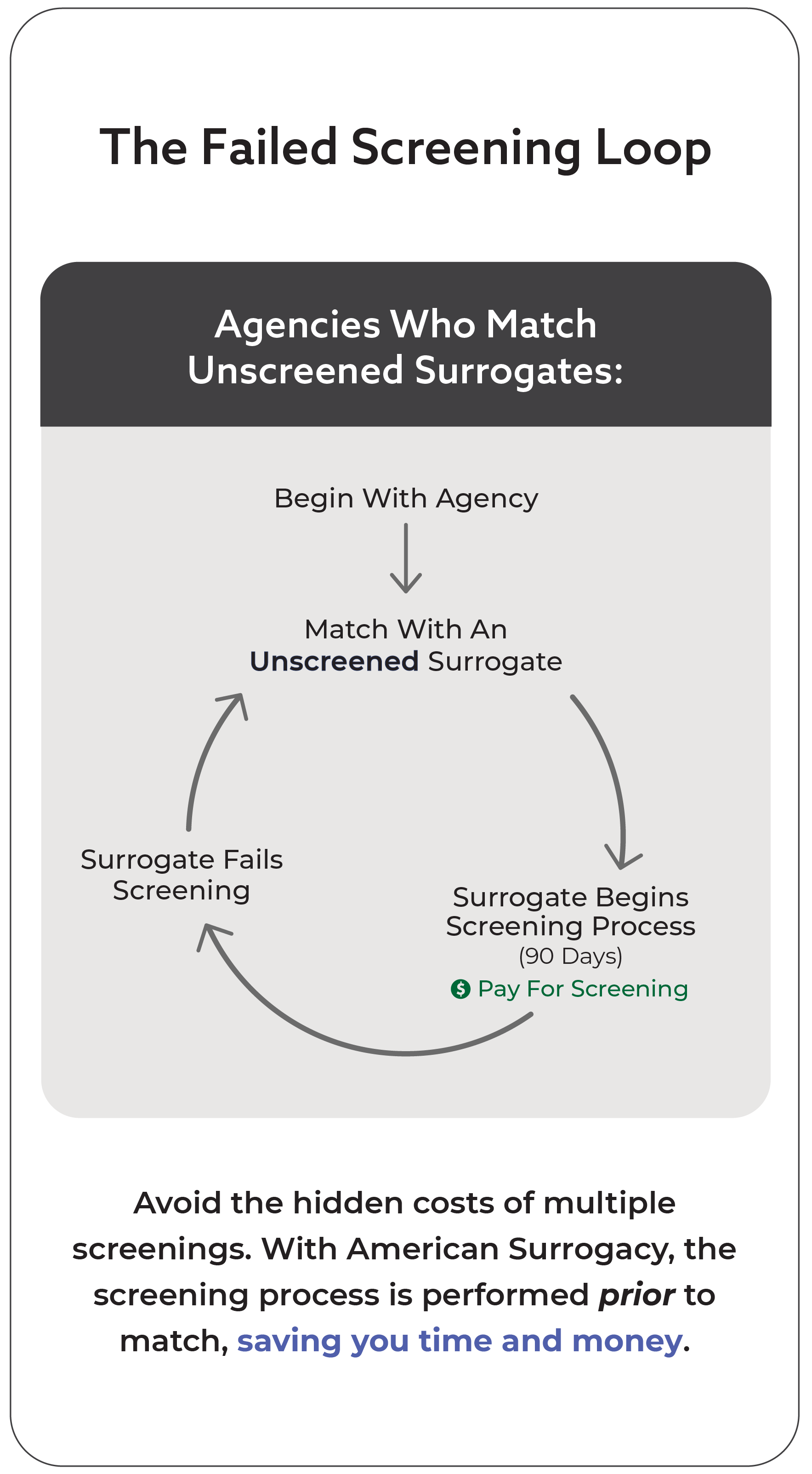
This early screening is one of the most important ways your journey is protected. By identifying potential medical, psychological or lifestyle concerns upfront, American Surrogacy significantly reduces the risk of a failed match later in the process.
Without strong pre-screening, intended parents may experience what’s known as the “failed screening loop.”
Medical Screening With Your Fertility Clinic
Your specific fertility clinic must grant final approval during surrogate medical screening.
Typically, there are several medical tests that surrogates have to pass at a fertility clinic:
-
Bloodwork to check for infectious diseases and hormone levels
-
Hysteroscopy or saline sonograms to ensure a healthy uterine cavity
-
Physical exams and drug screenings
We understand that the fear of failed medical clearance at the clinic stage is a concern for intended parents. However, our pre-screening process is specifically designed to minimize this risk. By the time a surrogate reaches your clinic, she is highly likely to qualify.
To further protect your dreams and your investment, American Surrogacy offers a Limited Risk Program. If your surrogate does not pass the final screening at your clinic, this program lets you rematch with another qualified surrogate without paying additional agency fees.
Once clearance is granted, your surrogate moves forward with the in vitro fertilization (IVF) protocol outlined by your fertility clinic. She will follow a medication schedule designed to support and build her uterine lining. This phase typically lasts one to two months. Your surrogate will likely take a combination of medications, such as: Lupron: Used to suppress ovulation so the clinic can carefully control the timing of the transfer cycle Estrogen: Administered via oral pills, patches or injections to help thicken the uterine lining Progesterone: Given as intramuscular injections beginning several days before transfer to help support implantation and early pregnancy Throughout the start of the medical process for surrogacy, your fertility clinic will monitor her progress through lining checks — ultrasound and bloodwork appointments that confirm her body is responding appropriately.Preparing Your Surrogate for Embryo Transfer
Embryo Transfer for Surrogacy
Depending on your family-building journey, you may have personal experience with IVF. But you may still wonder how embryo transfer works in surrogacy.
The embryo transfer is an important milestone. This is a relatively quick, non-surgical procedure where a doctor uses a fine catheter to place your frozen embryo into the surrogate’s uterus.
The process itself is straightforward and typically painless for the surrogate. The appointment usually takes less than an hour, with the actual transfer lasting only a few minutes.
After transfer, the two-week wait begins before a pregnancy test can confirm the results.
What Happens if Embryo Transfer Fails?
It is a difficult reality to face, but sometimes a transfer does not result in pregnancy. If that happens, your fertility doctor will review the cycle carefully to determine whether any adjustments should be made before another attempt.
If your journey requires another transfer — or even moving forward with a different gestational carrier — having a financial safety net can make the situation feel more manageable. Families enrolled in our Limited Risk Program can rematch with another surrogate without paying additional fees.
Around 9 to 14 days after the embryo transfer, your fertility clinic will schedule a beta hCG blood test to determine whether pregnancy has occurred. This test measures the level of pregnancy hormone in your surrogate’s bloodstream and provides the most accurate answer. Some intended parents and surrogates choose to take an at-home pregnancy test before the appointment. While that can offer an early glimpse, the blood draw gives clear, measurable results and allows doctors to track whether hormone levels are rising appropriately over the following days. When levels increase as expected, the pregnancy is medically confirmed. Your clinic will continue monitoring through additional bloodwork and early ultrasounds to check for a gestational sac and, shortly after, a heartbeat. These early weeks involve careful follow-up before your surrogate transitions into standard prenatal care with her OB-GYN provider.Pregnancy Confirmation and Early Monitoring
The Surrogate Pregnancy: What Happens During the 9 Months
Once a heartbeat is confirmed by ultrasound, care typically shifts from the fertility clinic to a local OB-GYN. This “graduation” usually takes place around weeks 10 to 12, marking the point when the surrogate pregnancy is considered stable enough for routine prenatal care.
Many intended parents wonder how involved they can be in the medical process during these nine months — especially when they live in a different state or even another country. Fortunately, technology can bridge that distance. You can remain closely involved throughout the pregnancy by:
-
Attending prenatal appointments in-person or via FaceTime or Zoom
-
Receiving real-time ultrasound updates and photos
-
Sharing milestones like the 20-week anatomy scan
-
Regular text or video call check-ins regarding how she is feeling
Most surrogates value open communication and genuinely enjoy keeping intended parents included as the pregnancy progresses.
As the due date approaches, the surrogacy birth plan outlined in your contract helps guide the hospital experience. Your American Surrogacy specialist coordinates with the hospital in advance so that staff understand everyone’s roles and expectations before delivery day arrives. Here’s what you can expect when your surrogate gives birth: Clear Roles: Your surrogate remains in control of her medical care throughout labor and delivery. Once your baby is born, you assume full parental rights and medical decision-making responsibility. Bonding Time: Many birth plans prioritize skin-to-skin contact and private time for you and your baby shortly after delivery. Hospital Accommodations: Whenever possible, arrangements are made for you to room with your baby, and hospital staff are prepared with the necessary documentation to reflect your parental status. If your baby requires time in the NICU, you will have the same access and authority as any parent to be present and participate in medical decisions.What to Expect at the Hospital When Your Surrogate Gives Birth
Medical Risks and Safety Protocols
Every pregnancy carries some degree of risk. Possible complications can include chemical pregnancy, gestational diabetes, preeclampsia or the need for a cesarean delivery.
To protect everyone involved, thorough medical screening and clear safety protocols are in place from the beginning. Our agency coordinates a comprehensive insurance review for each surrogate so that, if complications arise, appropriate coverage is established in advance.
American Surrogacy and most fertility clinics recommend transferring a single embryo whenever possible. This reduces the risks associated with multiple pregnancies, helping safeguard both the surrogate and your baby.
Throughout the surrogacy medical process, American Surrogacy serves as your advocate and coordinator. Here’s how we support you: Surrogates are fully qualified before matching, helping reduce delays and unexpected medical complications later in the process. We coordinate with your fertility clinic and the surrogate to ensure everyone is aligned. Funds are distributed from your escrow account in a structured, transparent way so medical-related expenses are handled accurately and on time. We handle the clinic scheduling and escrow payments so you don't have to manage the paperwork yourself. If you have questions about the medical costs, we can walk you through a sample budget. Our role is to handle the logistics so you can focus on what truly matters — building your family. If you’re ready to move forward with experienced guidance and steady support, connect with one of our surrogacy specialists today. Disclaimer: This content is for informational and educational purposes only and does not constitute medical advice, diagnosis or treatment. Always seek the advice of a licensed healthcare provider with any questions you may have regarding a medical condition or procedure.How American Surrogacy Supports the Medical Process